Loading
Ordering custom teamwear presents a significant risk: the sample looks perfect, but the bulk order arrives with inconsistent sizing, and the colors fade dramatically after just a few washes. For procurement managers and team organizers, this is a costly mistake that disappoints players and reflects poorly on their decision. The goal is not just to find a cheap supplier, but to secure a durable, high-performance Lightweight Custom Soccer Kit that holds its color and fit throughout the season. Understanding the key variables in fabric, printing, and supplier capability is the only way to protect your investment.
Many teams are forced to re-order mid-season because their initial kits couldn’t withstand regular use and laundering. At Hening Clothing, we’ve seen this happen too often. That’s why we focus on solving these core problems directly. By using specific locked-color inks and a verified size chart across our ISO 9001-certified production line, we help teams get the quality they expect. This guide breaks down the critical factors that determine the final cost and long-term value of your team’s uniforms.
The fabric is the foundation of any quality soccer uniform. While “100% polyester” is the industry standard, not all polyesters are created equal. The weight, weave, and finish determine the kit’s breathability, comfort, and ability to endure a tough season. Focusing on these three specifications will ensure you get a material fit for athletic performance.
Grams per Square Meter (GSM) measures the density of the fabric. For soccer, the ideal range balances durability with breathability. Heavier fabrics are more durable but can trap heat, while extremely light fabrics may not withstand tackles and slides.
Modern sportswear fabric technology offers more than just durability. Look for these essential features:
The way the polyester fibers are knit together affects both the feel and function of the garment. Interlock knits are smooth and stable, making them a popular choice for the main body of Soccer Jerseys. For enhanced ventilation, many designs incorporate side panels made from a more open-weave mesh. This targeted ventilation is a mark of a well-designed kit.
Calculating the soccer team uniform cost involves more than just a single unit price. Several factors influence the final quote, and understanding them allows you to adjust your specifications to meet a target budget. As a manufacturer with no MOQ, we offer flexibility, but pricing is always dependent on order complexity and volume. Here is a breakdown of the key cost drivers.
| Cost Factor | Description | Impact on Price |
|---|---|---|
| Order Quantity | The total number of kits in a single order. Price per unit decreases as quantity increases due to economies of scale in printing and cutting. | High. Ordering for three teams at once, like an Australian soccer club we supplied, results in a lower per-unit cost than ordering for a single small team. |
| Printing Coverage | The extent of the dye-sublimation print. A simple chest logo costs less than a full-wrap, multi-color graphic design that covers every inch of the fabric. | Medium. Full sublimation requires more ink, larger print paper, and more precise labor, which adds to the cost. |
| Fabric Weight & Type | The base cost of the raw material. A standard 140 gsm moisture-wicking polyester is the baseline. Specialized fabrics with anti-microbial finishes or higher GSM will cost more. | Low to Medium. The difference between 140 gsm and 160 gsm is usually minor, but custom-milled fabrics can increase costs significantly. |
| Construction Complexity | Additional features like mesh ventilation panels, complex collar designs (e.g., buttoned polo vs. standard V-neck), or custom ribbed cuffs. Each extra seam and component adds labor time. | Medium. Adding two side mesh panels is a common request that slightly increases the price but greatly improves performance. |
| Landed Costs | This includes shipping, duties, and taxes. These costs are not part of the production price but are a major component of the final budget. They vary by destination country and shipping method (air vs. sea). | Variable. This cost must be calculated separately based on your location and delivery timeline. |
Dye sublimation is the best method for creating complex, full-color designs that don’t crack, peel, or fade easily. The process infuses ink directly into the fabric fibers. However, poor execution leads to disappointing results. Many buyers receive Custom Team Jerseys that lose their color vibrancy after just a few washes—a common complaint we solve for our clients.
The quality of dye sublimation soccer kits depends entirely on the manufacturer’s process control. At our facility in Guangzhou—a city with a complete industrial chain for sportswear—we have refined our process to eliminate common failures. With a daily output of over 1000 custom jerseys from our five automatic printing lines, consistency is key.
Solution: We use high-quality, locked-color inks imported from Italy and have calibrated our equipment precisely. This is why we can confidently offer a 1-year colorfastness guarantee on all our kits.
Solution: We use a pre-verified size chart and a rigorous quality control system that measures garments post-production. We offer a free reprint for any wrong size, ensuring your team gets a uniform fit.
Solution: Our automatic production lines and experienced technicians minimize manual handling errors, ensuring every logo and number is sharp and clear.
The quality of your kit is a direct result of the supplier’s attention to detail. This was critical when we produced over 500 sublimated Basketball Jerseys for a US high school league, where every jersey had to be perfect and consistent across multiple teams.
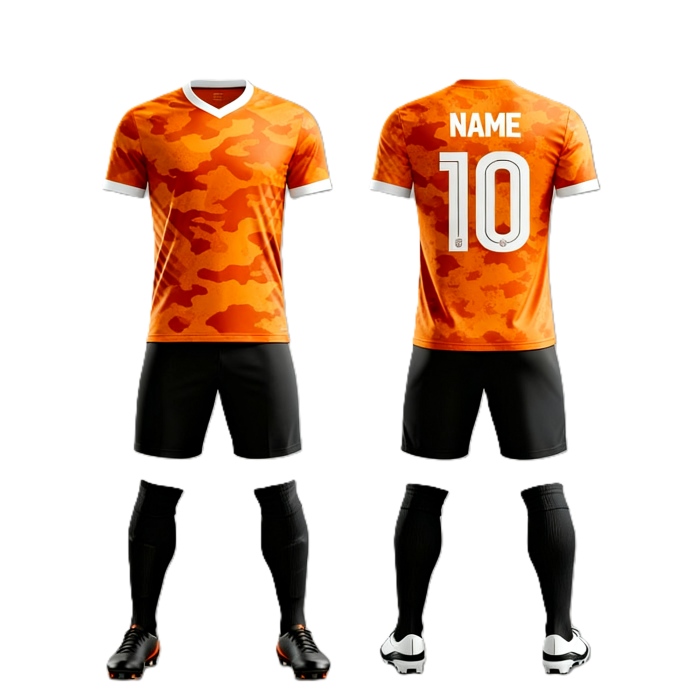
Choosing the right soccer jersey manufacturer is the most important step. A low price from an unreliable supplier often leads to higher costs in the long run due to delays, defects, and the need for replacements. Use this checklist to evaluate potential partners and make an informed decision.
Look for internationally recognized standards like ISO 9001 (quality management) and ISO 14001 (environmental management). These indicate that the supplier has proven, repeatable processes for ensuring quality and consistency. Our factory holds both certifications.
Many large factories won’t accept orders below 100 or 200 pieces. If you are a small club or need just a few extra kits, you need a supplier with a flexible policy. We have no MOQ, making us a suitable partner for teams of any size.
Ask for both standard and rush production timelines. A reliable supplier will give you a clear window. Our standard production is 7-10 days, with rush options available for urgent orders.
A supplier’s experience in your region (e.g., Europe, Australia, North America) means they are familiar with the specific sizing conventions, quality expectations, and shipping logistics. We have supplied teams and retailers across the US, Australia, Europe, and New Zealand.
Do not place an order without a clear policy on reprints or refunds for printing defects, incorrect sizing, or color fading. A confident manufacturer will stand behind their product, as we do with our free reprint and 1-year colorfastness policies.
By asking these questions, you move the conversation from price to value, ensuring your team receives a lightweight custom soccer kit that performs well and represents your club proudly all season long.
Ready to get started on your team’s next uniform? Send us your design specifications to get a detailed quote and expert advice on choosing the right fabric for your needs.






 WhatsApp
 Email
 +8618978569271