Loading
The FOB price on a quote is the number buyers compare, and it is rarely the number that decides the margin. Importers who skip the landed cost sum tend to find out about duty, freight spikes and defect losses only after the container is booked. For hoodies, which are bulky and carry a high freight cost per unit, the gap between quote and real cost can be large. This guide shows how to build the full figure before you sign a purchase order.
I’m Linjing He, and I have spent 10 years in custom sportswear manufacturing. The most common quoting mistake I see is comparing two FOB prices as if they were two final prices. They are not.
Landed cost is everything you pay to get a finished garment onto your own shelf, ready to sell. A usable landed cost calculator needs six inputs, and each one has a different level of certainty.
Our rule is simple. Treat only the FOB price as confirmed once you hold a written quote. Everything else starts as an estimate or an unknown, and you should label it that way in your spreadsheet.
A single order can hide problems that a multi-year view exposes. If you plan to reorder, model five years. Freight rates, duty rules and defect rates all move, and your reorder rhythm decides how much stock you carry. The table separates what you can confirm from what you must estimate.
| Cost component | Status | Source of the number | What changes over five years |
|---|---|---|---|
| FOB price | Confirmed per quote | Written factory quote, tied to quantity | Reprices with volume, fabric and exchange rate. Quotes are not locked for five years. |
| Freight | Estimated | Freight forwarder quote, per carton or cubic metre | Rates move with season and fuel. Re-quote every order. |
| Import duty | Unknown until classified | Customs broker, based on garment classification and fabric | Trade rules can change. Check each year. |
| Defect allowance | Estimated | Your tolerance plus the factory’s written replacement terms | Falls if the supplier’s quality record holds. Track it order by order. |
| Inventory carrying costs | Estimated | Your own storage, finance and sell-through data | Depends on reorder frequency and how fast sizes sell. |
| Local delivery and brokerage | Estimated | Broker and carrier invoices | Usually stable, but check it. |
The figures below are assumptions for arithmetic only. They are not our prices, not a duty rate and not a market benchmark. Replace each one with your own quote before you act on the result.
The landed total comes to $17.40 per unit, which is 24% above the FOB price. At 1,000 units a year, that is $17,400 annually and $87,000 over five years if nothing changes.
Now stress the inputs. If the defect allowance rises from 2% to 5%, you add $0.42 per unit, or $2,100 over five years. If freight rises 30%, you add $0.27 per unit, or $1,350. Neither is dramatic alone, but together they erode a thin margin. This is where bulk order margins are won or lost.
Limits of this model: It assumes flat volumes and flat prices. It also ignores currency swings and returns from your own customers. Use it to rank suppliers and test a margin, not to forecast to the cent.
An FOB price quote is only comparable when the specification behind it is identical. Before you put two quotes side by side, confirm these points in writing.
On our side, there is no MOQ, though pricing depends on quantity. A small club can order 50 pieces and a retailer can order 2,000, and the unit price will differ. That is why a quote must name the quantity it was built on. For standard production our stated timeline is 7 to 10 days, and rush orders are available. Our figures above come from our jersey production, so ask for hoodie fabric, gsm, lead time and warranty terms in writing before you rely on them.
Many importers set defect allowance at a flat percentage because it is easy. That works until one bad batch hits. A better approach is to tie the allowance to the supplier’s written remedy.
Our stated terms include a free reprint for any printing defect or wrong size, plus a one-year colorfastness guarantee. In practice, that lets a buyer set a lower allowance for those two failure types. It does not cover everything. If a defect type is not named in the terms, such as a stitching or fabric flaw, price it into your allowance or get it agreed in writing. We run an ISO 9001 certified quality system and an ISO 14001 environmental system, but a certificate does not replace a clear remedy clause in your purchase order.
Two real examples show why print and size accuracy matter. We supplied 500+ sublimated jerseys for a US high school basketball league and produced full custom uniforms for an Australian soccer club’s three teams. In both, wrong sizes and faded prints were the risks that would have cost the buyer most. We used locked color inks and a verified size chart to control them. These cases were jerseys, not hoodies, but the same size and color discipline applies to any bulk apparel order.
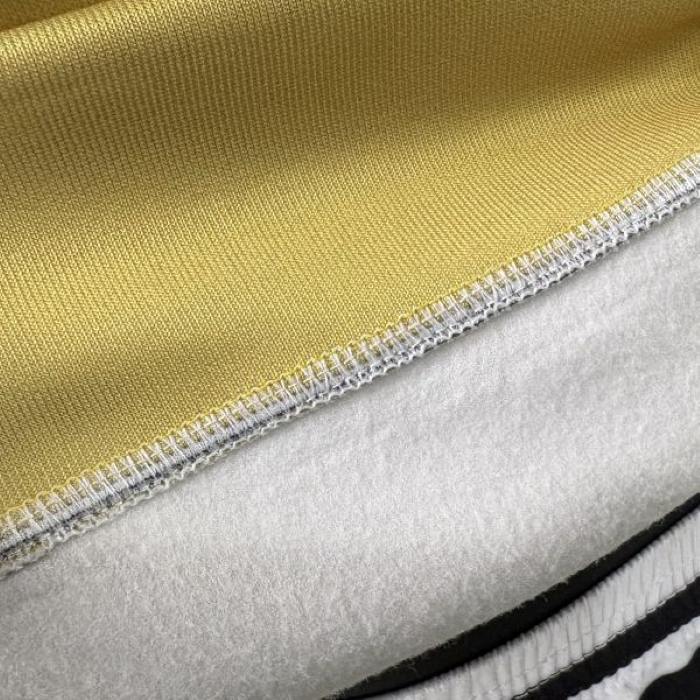
Hoodies sell in a season, so stock held past that season costs more than stock sold on time. Carrying cost is the input buyers most often leave at zero.
| Ordering approach | Fits when | Cost pressure | Limit |
|---|---|---|---|
| One large annual order | Demand is predictable, such as a retailer’s winter line | Lower unit price and freight, higher carrying cost | Risky if sizes sell unevenly |
| Two to four smaller orders | Demand is uncertain or cash is tight | Higher unit price, lower carrying cost | More freight bookings and customs entries |
| Small test order, then scale | New design or new supplier | Highest unit cost, lowest risk | Slower to reach target margin |
With no MOQ, a first order can be a test run. The unit price will be higher, but you learn the real defect rate and real transit time before you commit capital. Our standard 7 to 10 day production window also helps. Shorter lead times let you hold less safety stock.
If you also source team kits or outerwear, the same method applies to Custom Team Jerseys and a Custom Sport Jacket. For relaxed lifestyle lines, see our Custom Casual Wear range. We have delivered 1000 event jerseys for a European marathon and supplied training sportswear to sports retailers in New Zealand. That makes quantity-based pricing and export paperwork routine for us.
Send us your target quantity, decoration and destination port, and we will return a written quote you can drop straight into your landed cost sheet.






 WhatsApp
 Email
 +8618978569271