Loading
The expensive mistakes in a uniform program rarely show up at the quote stage. They show up when 300 garments arrive and the logo sits two centimeters too low, the navy differs from last season’s batch, or the size run leaves half the staff with no usable fit. If you are sourcing polo shirts for a corporate team, a distributor catalog or a club, most of those problems can be prevented by deciding five things before the RFQ goes out: fabric, size ratio, decoration method, approval steps and delivery date.
Retail polo pages talk about cotton versus linen, slim versus regular fit, and short versus long sleeves. A procurement manager needs something different: a way to compare suppliers on repeatability, defect responsibility and timeline. This guide covers that, and is clear about where our own capability applies and where you should ask questions first.
Hening Clothing Co., Ltd runs a 1000 sqm factory in Guangzhou, China, with 100+ workers and five automatic dye-sublimation printing lines. Daily output is 1000+ custom jerseys. Our core business is custom sublimated sportswear, so the best fit for us is a polo program built on performance polyester rather than cotton piqué.
Our fabric is 100% polyester, moisture-wicking, with 4-way stretch at 140-160 gsm. That suits sports clubs, event staff, school teams, promotional teams and active-duty corporate uniforms. It does not suit a buyer who needs 100% cotton or linen. If that is your requirement, tell us at the start so neither side wastes time.
Two other things to confirm up front: polo-specific construction details such as collar type, placket style and sleeve cuffs, and any embroidery requirement. Neither appears in our standard capability list, so we treat both as items to verify on a sample before we agree to a bulk spec. You can see our existing sublimated range under Custom Team Jerseys and Custom Casual Wear to judge print quality and fabric hand-feel.
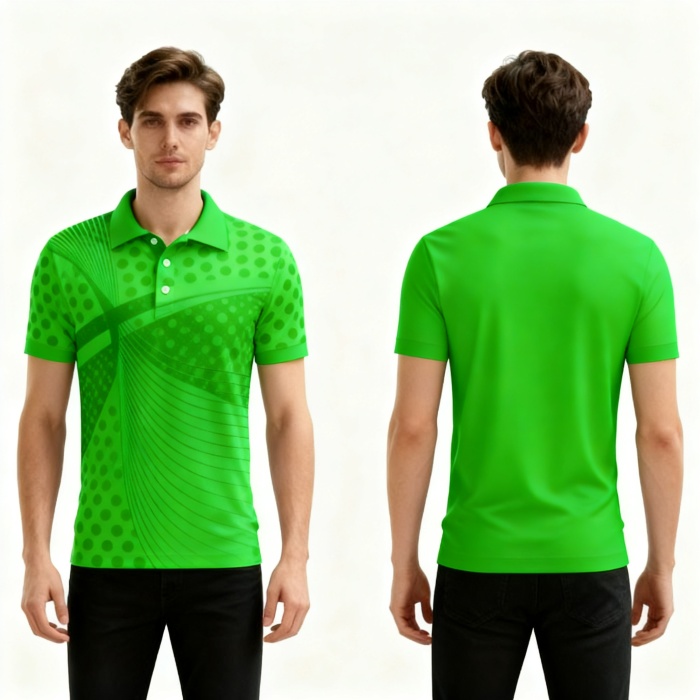
The table below is a planning sequence you can use with any supplier. It is a buyer’s checklist, not a claim that every order follows an identical path. Steps marked “confirm” depend on the quote you receive.
| Step | What to decide | What to ask the supplier | Limit or risk |
|---|---|---|---|
| 1. Fabric match | Climate, wear time, wash frequency, desired hand-feel | Fiber content, gsm, stretch and wicking performance | Our 140-160 gsm polyester is breathable; it will not feel like cotton |
| 2. Size run | Headcount by size, gender cut, spare stock | Which size chart is used and whether it is verified against a sample | Sizing differs between brands; never reuse a retail chart |
| 3. Decoration | Sublimation, embroidery or both; logo position and size | Written logo placement spec; whether embroidery is supported for your order | Sublimation suits full-color artwork; embroidery needs separate confirmation |
| 4. Sample approval | Color, fit, collar shape, print sharpness | Sample cost, timing, and what changes after approval | A sample approves only what you inspect; log every note in writing |
| 5. Delivery date | In-hand date, not ship date | When the 7-10 day standard production clock starts; rush options | Production time excludes freight and customs |
Work backward from the date staff need the garments. Subtract freight, then production, then sample approval. If the result lands in the past, ask about rush production early instead of compressing the sample stage, because that is where fit errors slip through.
Decoration drives both look and cost. Here is how the main options compare for a performance-fabric uniform.
| Method | Best for | Watch out for |
|---|---|---|
| Dye-sublimation | Full-color logos, gradients, all-over team designs, polyester fabric | Works on polyester; colors depend on the base fabric shade. We use locked-color inks, and our 1-year colorfastness guarantee covers fading. |
| Embroidery | Small left-chest logos on corporate uniforms | Not part of our listed capability. Confirm availability, stitch density and fabric suitability before committing. |
Our recommendation: if your logo has more than two or three colors, or you want sleeve and collar graphics, sublimation is usually the simpler route on polyester. If your program requires a stitched left-chest mark above all else, ask us directly whether we can support it on your quantity before assuming so.
Teams often struggle with inconsistent sizing. We handle this with a verified size chart, but you still need a sensible ratio. The example below is illustrative, not a real customer order.
Scenario: a 60-person staff uniform, mixed gender, office and field roles.
That is 60 garments. For a second-wave order, add a 5-10% buffer in the two middle sizes for new hires, since a re-run later costs more per piece than a larger first batch. Where staff turnover is low and the budget is tight, skip the buffer and reorder in small quantities instead. We have no MOQ, though pricing is based on quantity, so small top-up orders are possible but will cost more per unit.
Before finalizing, collect real measurements from a sample of five to ten staff and compare them to the supplier’s size chart. Wrong-size claims are far easier to settle when the chart was agreed in writing. If a size error is our fault, we offer a free reprint for wrong size.
Ask every shortlisted supplier for three things: certifications, relevant order history and a written defect policy. Here is what we can provide.
Be careful how you read this. These cases are team jerseys, singlets and training wear, not polo programs. They show sublimation quality and multi-team repeatability at volume, not polo-specific collar construction. That is why a pre-bulk sample matters. Related categories such as Soccer Jerseys and Basketball Jerseys show the print and fabric quality behind those cases.
The supplied terms are straightforward: no MOQ, pricing based on quantity, standard production of 7-10 days with rush orders available, free reprint for printing defects or wrong sizes, and a 1-year colorfastness guarantee.
These points still need to be agreed in writing for your order:
We do not treat our target markets (the United States, Australia, the United Kingdom, Europe and Japan) as a claim of local stock or market-specific approvals. If your program needs labeling, safety or compliance documents for a particular country, raise that before ordering.
With those details we can tell you quickly whether your polo program suits our sublimated polyester production. For jackets or matching outerwear, see our Custom Sport Jacket range. To start, send your logo, quantity and target date to our team and request a quote and sample plan.






 WhatsApp
 Email
 +8618978569271