Loading
Placing a bulk order for a custom soccer jacket without a clear understanding of your material specifications is a direct path to eroding your profit margins. You might receive a quote that seems competitive, only to find the final product is too thin for your climate, lacks the durability your team needs, or uses a fabric that causes your logos to fade after a few washes. The single biggest variable in your per-unit cost isn’t the design; it’s the fabric and finishes you choose before production even begins.
As a sportswear production specialist, I’ve seen importers focus heavily on logo placement and color matching while glossing over the technical sheet. This is a mistake. The weight, weave, lining, and coating of the polyester determine not just the jacket’s performance but also its final landed cost. At Hening, we believe in transparency. We help you build a jacket that meets your team’s needs and your business’s budget, starting with the most critical component: the material itself.
Your final quote for a custom soccer jacket is built from several key material and production choices. Understanding how each one affects the price allows you to make informed trade-offs between performance features and budget constraints. Below is a breakdown of the primary cost drivers you need to consider when preparing your request for quotation (RFQ).
Many factories won’t separate these costs for you, but knowing the levers you can pull is essential for effective sourcing. This is how we approach building a specification with our clients to ensure there are no surprises.
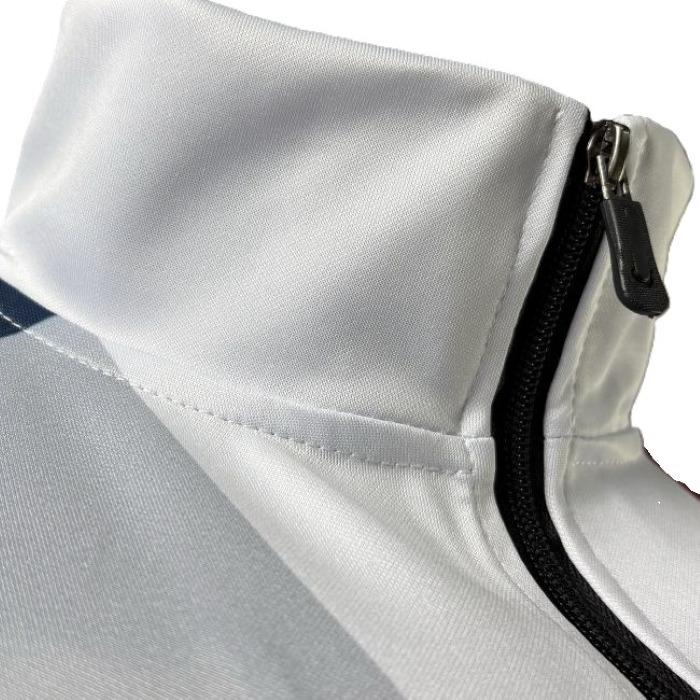
This table illustrates the relative cost impact of common material and decoration options. Use it as a guide to balance your budget with your team’s functional requirements.
| Component | Low-Cost Option | Mid-Range Option | High-Cost Option | Cost Impact Notes |
|---|---|---|---|---|
| Shell Fabric | Standard 100% Polyester Taffeta (140-160 gsm) | Polyester Dobby or Ripstop | Bonded Polyester Softshell (with membrane) | The shell is the largest material component. Heavier or more complex weaves like ripstop add durability and cost. Bonded fabrics offer the highest performance but significantly increase the price. |
| Lining | No Lining (Shell only) | Polyester Mesh Lining | Microfleece or Quilted Lining | A simple mesh lining adds breathability with a moderate cost increase. Fleece or quilted linings provide warmth but add substantial material and labor costs. |
| Waterproofing | None (Water-resistant fabric only) | DWR (Durable Water Repellent) Coating | Laminated Waterproof/Breathable Membrane | A DWR coating offers good value for light rain protection. A fully laminated membrane provides true waterproofing but is a premium feature reserved for all-weather jackets. |
| Decoration | Dye-Sublimation (on white base fabric) | Screen Printing (1-3 colors) | Embroidery or Heat-Transfer Vinyl (complex logos) | For full-color, complex designs, our dye-sublimation is the most cost-effective method. Embroidery adds a premium feel but is priced per stitch count and becomes expensive for large logos. |
By using this framework, you can specify a jacket that aligns with your budget. For example, a training jacket for a youth league in a mild climate could use a standard polyester shell with a mesh lining and no DWR coating, keeping costs low. Conversely, a travel jacket for a semi-professional team in a rainy region would justify the higher cost of a DWR-coated ripstop shell and fleece lining. We regularly help teams, like the Australian soccer club we supplied, to configure uniforms for different needs across their organization.
The shell fabric is the foundation of your soccer jacket. It dictates the garment’s durability, weight, and feel. While almost all team jackets use 100% polyester for its strength and moisture-wicking properties, the specific weave and weight (measured in grams per square meter, or gsm) create significant differences in performance and price.
At our 1000 sqm factory in Guangzhou, we primarily work with polyester fabrics in the 140-160 gsm range. We find this offers the best balance of lightweight breathability and durability for most athletic applications. Our standard fabric is a moisture-wicking, 4-way stretch polyester that moves with the athlete without restricting motion. This is the same material we used for the 500+ Basketball Jerseys we supplied to a US high school league, proving its reliability in demanding conditions.
Your choice depends on the jacket’s intended use. For pre-game warm-ups and general team wear, a standard polyester taffeta or dobby is usually sufficient. For contact-heavy training sessions or travel in harsh weather, investing in a ripstop or softshell fabric may be worthwhile.
Making the right material choices is about more than just picking the most expensive option. It’s about matching the specification to the application. Over-engineering a simple training jacket can be as wasteful as under-specifying an all-weather piece. Here are three common mistakes we see buyers make that unnecessarily drive up their costs.
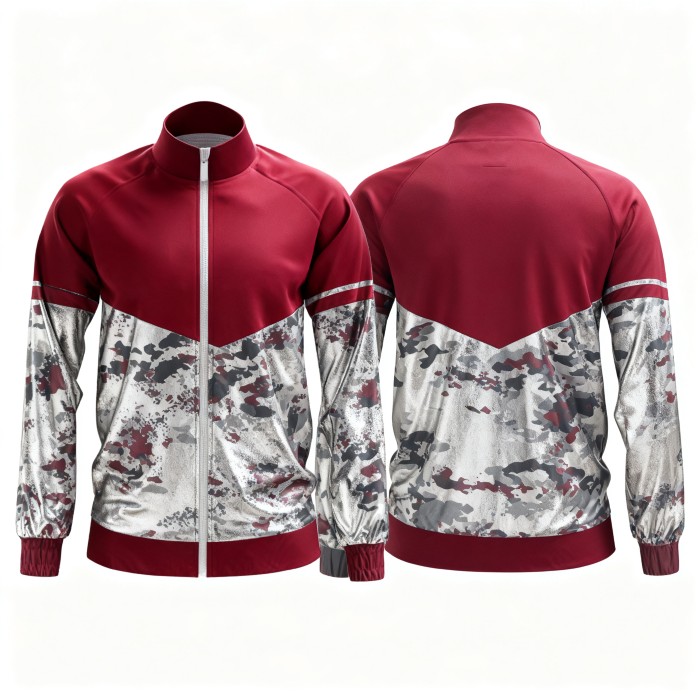
Avoiding these pitfalls requires clear communication with your manufacturer. At Hening, our ISO 9001 certified processes ensure we review your specifications and advise on the most cost-effective way to achieve your desired outcome. We also offer Custom Sport Jacket options tailored to your exact needs.
As a manufacturer, our role is to translate your vision into a high-quality, finished product that fits your budget. We achieve this through a combination of modern technology, a skilled workforce, and a strategic location within a complete industrial supply chain.
Our facility is not just a workshop; it’s an ISO 9001 and ISO 14001 certified operation. These certifications reflect our commitment to consistent quality management and responsible environmental practices. With over 100 skilled workers and 5 automatic dye-sublimation printing lines, we have the capacity to produce over 1000 custom jerseys daily. This scale allows us to source materials at competitive prices and manage production efficiently, passing those savings on to you.
From producing running singlets for events in Zimbabwe to outfitting sports retailers in New Zealand, our experience is broad. By controlling the entire production process—from printing to cutting and sewing—in our Guangzhou factory, we eliminate the variables that can lead to delays and cost overruns when working with multiple subcontractors.
Choosing the right fabric is the first step in sourcing a successful soccer jacket. The next is choosing the right partner to produce it.
Ready to get a detailed cost breakdown for your specific design? Send us your specs for a transparent quote and let’s build the perfect jacket for your team.






 WhatsApp
 Email
 +8618978569271