Loading
Most teams don’t regret ordering the wrong basketball jerseys because of price. They regret it because the delivery date slipped, the sizing chart didn’t match real bodies, or the sublimated numbers cracked after four washes. Before you send an RFQ to any supplier, you need to know which mistakes are common, which lead times are realistic, and where the line sits between “just buy stock” and “get this custom made.” That’s what this guide answers, plainly, without sales fluff.
Stock jerseys make sense for one-off pickup games, walk-on tryout sessions, or programs with zero budget for branding. They ship fast, they’re cheap per unit, and nobody argues about color codes.
The limits show up quickly for anything resembling a real program:
If your team plays more than a handful of games a year, or if sponsors and school names appear on the shirt, stock starts costing you more in reprints and mismatched sets than a custom run would have upfront.
Here’s the honest breakdown of when custom ordering makes sense versus when it’s overkill.
| Factor | Choose Stock | Choose Custom |
|---|---|---|
| Team size | Under 10 players, casual play | 12+ players, league or club rosters |
| Turnaround deadline | Need jerseys in 48-72 hours | 7-10 days standard, rush available for tighter windows |
| Logo complexity | No logo or single-color print | Multi-color logos, sponsor names, player numbers, sublimated patterns |
| Reorder needs | One-time purchase, no repeat | Seasonal reorders needing exact color and size match |
The boundary isn’t about budget alone — it’s about whether you’ll need this exact design again. A club with three age-group teams, for example, benefits from custom because every squad needs matching colorways that can be reproduced next season without guesswork. That’s the same setup we handled for an Australian soccer club ordering full uniforms across three teams — the point wasn’t just the first order, it was making sure reorders next season matched without drift in shade or fit.
For a single weekend tournament with no sponsor logo, stock is fine. Don’t overspend on custom tooling for a team that disbands after one season.
Custom basketball jerseys typically break down into these cost components:
A rough rule: expect custom sublimated jerseys to cost more per unit than blank stock at small quantities, but the gap narrows fast past 30-50 units, and the reprint risk (and its cost) drops to near zero with locked-color inks.
One case that illustrates the custom-versus-stock gap: a US high school basketball league needed 500+ sublimated jerseys across multiple squads, each with different number sets and school colors. Stock jerseys couldn’t cover the color variety without ordering from several vendors and risking mismatched shades. A single custom run solved that — one supplier, one dye batch standard, consistent sizing across every squad. That’s the scenario where custom stops being a luxury and becomes the practical choice.
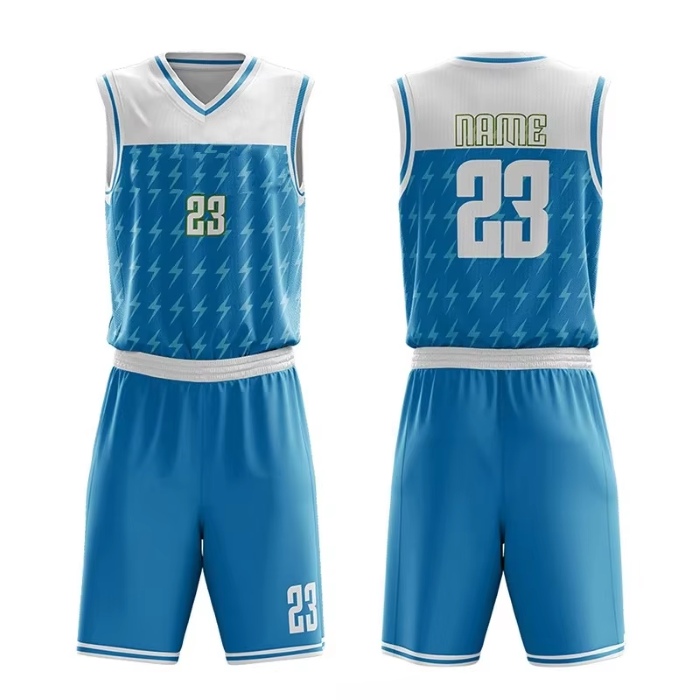
Not all sublimation is equal. Locked-color inks and a controlled printing environment are what prevent the classic complaint — jerseys that look sharp on delivery day and look washed-out a month later. Working with a facility certified under ISO 9001 for quality management and ISO 14001 for environmental management gives you a paper trail if something goes wrong, and it usually means tighter process controls on the production floor. Being based in Guiping, Guangxi — a town built around jersey manufacturing with a full local supply chain — also shortens the distance between fabric sourcing and final print, which helps keep both cost and lead time predictable.
Real order history backs this up: 1000 event jerseys delivered for a European marathon, training sportswear supplied to retailers in New Zealand, and running singlets produced for road races across Zimbabwe. Different sports, same underlying need — consistent color, consistent sizing, and a supplier who stands behind the print.
To be fair, custom sublimated basketball jerseys aren’t always the right call. Skip custom if:
In those cases, stock is the honest answer — no supplier should push custom on a buyer who genuinely doesn’t need it.
If you’re weighing custom against stock for your next season, send us your team size, deadline, and logo files — we’ll tell you straight whether custom makes sense for your order, and quote accordingly.






 WhatsApp
 Email
 +8618978569271