Loading
A half zip and a quarter-zip pullover look almost identical on a flat sketch. Picking between them is still not a styling coin toss. Zip length changes how the garment is worn, how much neck and chest area you can brand, and how many returns you get from buyers who wanted the other fit.
The working rule I give private-label buyers: choose the half zip when the pullover has to work as an open, ventilated mid-layer for active use. Choose the quarter-zip when it should look tidy when closed and carry a chest logo. That rule holds only if three inputs are settled: the target wearer, the fabric weight, and the decoration method. If any one is still open, sample both versions before you commit a range.
I have spent ten years on production floors making custom sportswear, and the most expensive mistakes I see come from skipping this step. A buyer picks a silhouette from a competitor’s product page, then discovers during sampling that the collar, zip and print layout all need rework.
The table below compares the criteria that actually change a private-label decision. Zip lengths are described relative to the body because the exact figure is set in your tech pack, not by the style name.
| Criterion | Half-zip | Quarter-zip | What it means for your label |
|---|---|---|---|
| Opening length | Zip runs to roughly mid-chest, giving a deep V when open | Zip stops near the upper chest, giving a shallow opening | Deeper opening means more ventilation and easier on/off; shallower opening keeps a cleaner closed look |
| Collar construction | Needs a collar that holds shape when open and lies flat when closed; stand collar or folded collar both used | Shorter zip supports a collar that stays upright with less structure | Collar finishing is where sample revisions cluster; specify height, tape and stitching in the brief |
| Layering use | Works as a mid-layer under a jacket, opened for temperature control | Works as a standalone top or light layer, usually worn closed | Activewear and training ranges lean toward the longer zip; casual and corporate ranges lean toward the shorter |
| Decoration area | Open chest zone is split by the zip, so logos sit left chest or lower; sleeves and back are free for larger prints | More uninterrupted chest area below the zip | If the chest logo is your brand signature, the shorter zip protects it |
| Zipper and trim demand | Longer zipper plus placket reinforcement | Shorter zipper, less placket work | Affects unit price; compare quotes only on matching specs |
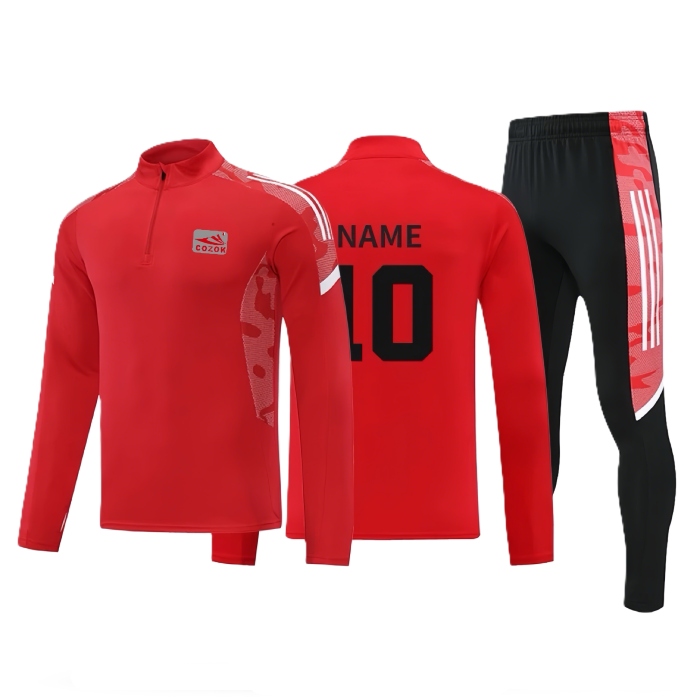
Read the table in this order: layering use first, decoration area second, collar third. Opening length is the most visible difference, but it rarely decides the order by itself. The collar is the quiet cost driver, because a collar that flares or twists when worn open is the usual reason a first sample gets rejected.
Limit: on a slim, fitted cut, the long zip can gape at the chest when open. Check it on a fit sample, not only a flat photo.
Limit: in warm conditions or intense activity, the shallow opening can feel restrictive, and wearers will say so in reviews.
Team and club programs often fall here. Consider an order spanning several squads, like the full custom uniforms we produced for an Australian soccer club’s three teams. The sleeve and back prints and color matching with the match kit matter more than the zip length. In that case, pick the length that suits the coaching staff’s use and keep the colors consistent with your Custom Team Jerseys.
For polyester pullovers, our standard fabric profile is 100% polyester, moisture-wicking, with 4-way stretch in the 140-160 gsm range. That weight is chosen for breathability. Here is what that means for a pullover decision:
Limits: sublimation requires polyester, so cotton-rich fabrics are outside this method. And if your label wants a heavy thermal or brushed-fleece pullover, the 140-160 gsm profile may be too light. Confirm available fabrics for that weight before you design around it. We have not listed heavier options here, so I won’t promise them.
The print process is also proven at volume. We have supplied 500+ sublimated jerseys for a US high school basketball league and 1000 event jerseys for a European marathon, using the same production line type and color-lock approach. Those were jerseys, not pullovers, so treat them as evidence of print consistency, not of pullover-specific construction.
There is no MOQ, so a small label can start with a pilot run. Pricing is quantity-based, so the unit price will drop as volume rises. I cannot publish a price here because it depends on specifications you haven’t fixed yet. These are the inputs that move it:
The longer zip is not automatically the more expensive option. Collar construction can offset the zipper difference, so compare quotes only when both are built to the same spec.
On timing, standard production is 7-10 days, with rush orders available. Sample lead time and shipping are separate, and you should confirm them when you brief. Our factory in Guangzhou runs 5 automatic dye-sublimation printing lines with 100+ workers, with daily output of 1000+ custom jerseys. We operate under ISO 9001 quality management and ISO 14001 environmental management certification. That matters most when you need the second reorder to match the first.
Choose the half zip when your pullover is a training or warm-up mid-layer, ventilation matters, and the design relies on sleeve and back graphics.
Choose the quarter-zip when the chest logo is your brand mark, the garment is positioned as casual or corporate, or you want the least fit variation across sizes.
Still to confirm before bulk: exact zip length, collar construction, fabric weight for your climate, quantity-tier pricing, sample timing, and the approved size chart. Those six items settle most disputes later.
If you are comparing both silhouettes for a new range, send us a reference garment or tech pack with your target quantity, and we will propose a sample plan and quote for both zip lengths.






 WhatsApp
 Email
 +8618978569271