Loading
A buyer building a seasonal assortment faces a familiar split. Either you run one half zip silhouette in several colors and hope it covers every weather window, or you build separate pieces for separate uses and accept a longer spec sheet. Margin, returns and reorder speed all depend on that choice.
Most product pages treat the style as a single versatile pullover. That is fine for a shopper. It does not help a brand or bulk-program buyer decide how many fabric weights, zip depths and collar heights the range needs. This article works from end use backward: what each layer must do, which build suits it, and where the build stops being suitable.
One note on evidence. Our documented customer cases are team jerseys, uniforms and running singlets, not half-zips. Where this article shows a range plan, it is an illustrative scenario, not a completed project.
Three construction choices decide whether a half-zip works as a transitional layer, a training top or a casual piece. Change one and the garment shifts roles.
| Assortment role | Fabric weight | Zip length | Collar height | Why it fits | Where it stops working |
|---|---|---|---|---|---|
| Transitional weather (cool mornings, mild afternoons) | Upper end of our 140-160 gsm range | Mid to deep opening for fast venting | Mid-height, sits flat under a jacket | Enough body to cut wind chill on the move, light enough to pack or tie off | Sustained cold or wet conditions; anything needing heavier insulation than 160 gsm must be confirmed with us first |
| Training and warm-up | Lower to middle of 140-160 gsm | Deep opening for heat release | Low to mid, so nothing rubs the neck during movement | Moisture-wicking, 4-way stretch polyester keeps its shape through repeated reps and sprints | Cold-weather outdoor sessions where the top is the only layer |
| Casual layering (club wear, travel, staff) | Middle of the range | Shorter opening for a cleaner front | Taller, to frame the neckline over a tee | Reads as a finished garment, so it suits logo placement and team-color identity | High-output sport, where a tall collar traps heat |
The logic is simple. Weight sets temperature range. Zip length sets ventilation control. Collar height sets how the piece behaves as an outer or inner layer. A deep zip with a low collar is a training tool. A short zip with a tall collar is a lifestyle piece, even if the fabric is identical.
The limit: weight is the only variable that changes warmth materially, and our confirmed range is 140-160 gsm. For true cold-season fleece or brushed constructions, treat it as an open question and ask before you write it into the range plan.
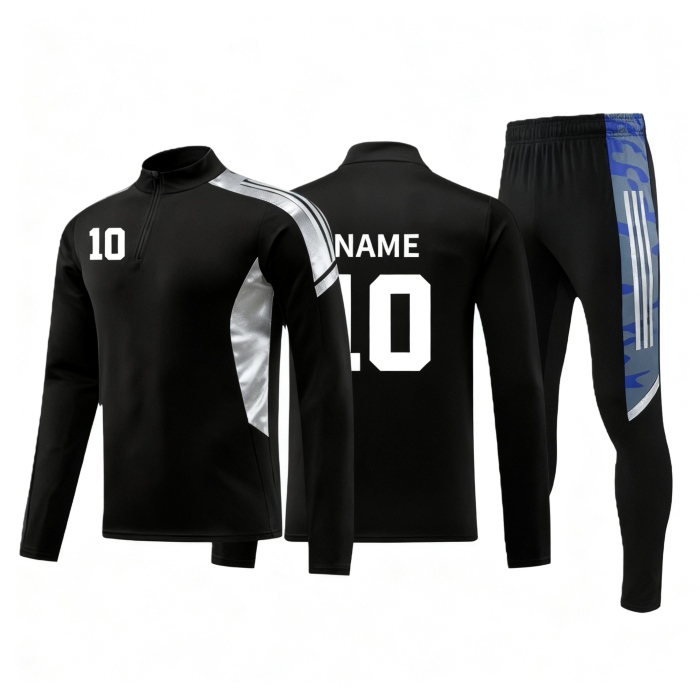
Once each role is defined, tie every requirement to a supported attribute and note its edge.
If a half-zip design needs a feature we have not listed, such as a specific zip hardware spec or a heavier knit, confirm it at the sample stage rather than assuming it.
We have supplied 500+ sublimated jerseys for a US high school basketball league, full custom uniforms for an Australian soccer club’s three teams, 1000 event jerseys for a European marathon, training sportswear for sports retailers in New Zealand, and running singlets for road-race events across Zimbabwe.
These show capability in multi-team coordination, event-scale volume and retail-oriented training apparel. They do not show a half-zip result. The Australian club case, for example, tells you we can keep colors and sizing aligned across three teams. It does not prove how a half-zip with a particular collar will perform in cold weather. Treat the cases as evidence of process, not of this garment.
For related styles in the same sublimation workflow, see our Custom Team Jerseys and Soccer Jerseys categories.
This is a planning example, not a past customer project. Suppose a sports retailer wants a cool-season capsule for amateur clubs.
All three share one fabric family and one color palette, so reorders stay simple and sizing logic carries across the line. Pieces one and two could pair with a Custom Sport Jacket for colder fixtures, and piece three belongs next to Custom Casual Wear in the assortment.
What this scenario cannot tell you is sell-through, ideal quantity split or the exact warmth of the transitional piece. Those need a sample and your own market data.
If a print defect or wrong size reaches you, we offer a free reprint.
This approach fits when your range is built on moisture-wicking polyester, your weather window is cool rather than cold, and team or brand color retention matters. It is a poor fit when you need insulation beyond the 140-160 gsm range, or a technical feature we have not confirmed.
If you are planning a layering range, send us your role list, target quantities and artwork, and we will advise on weight, zip and collar choices and quote a sample.






 WhatsApp
 Email
 +8618978569271