Loading
A catalog can make every supplier look capable. The risk appears after an RFQ is placed: the delivered jacket uses a different material combination, patches lack detail, sizing varies by batch, or the supplier cannot show who controls production. For buyers sourcing a Street Style Custom Football Jacket, the first task is not choosing colors. It is verifying whether the maker can reproduce the requested construction consistently.
Fashion-led football jackets often combine team identity with casual streetwear styling. A buyer may request a football-inspired body shape, contrast sleeves, rib trim, appliqué lettering, number placement, embroidery, and a branded lining. Those details require more evidence than a digitally rendered mock-up.
Hening Clothing Co., Ltd. should be assessed according to the scope supported by available evidence. We operate a 1,000 sqm factory in Guangzhou, China, with more than 100 workers and five automatic dye-sublimation printing lines. Our confirmed strengths are custom polyester sportswear, dye-sublimation printing, team-order flexibility, and production for sports apparel. Those strengths can be relevant when the requested jacket is primarily a polyester, sublimation-led sports jacket. They do not automatically prove capability for every varsity or mixed-material streetwear specification.
This distinction helps sourcing managers make a better shortlist. Buyers needing coordinated performance apparel can also compare our Custom Team Jerseys with jacket requirements, rather than treating all outerwear as one product category.
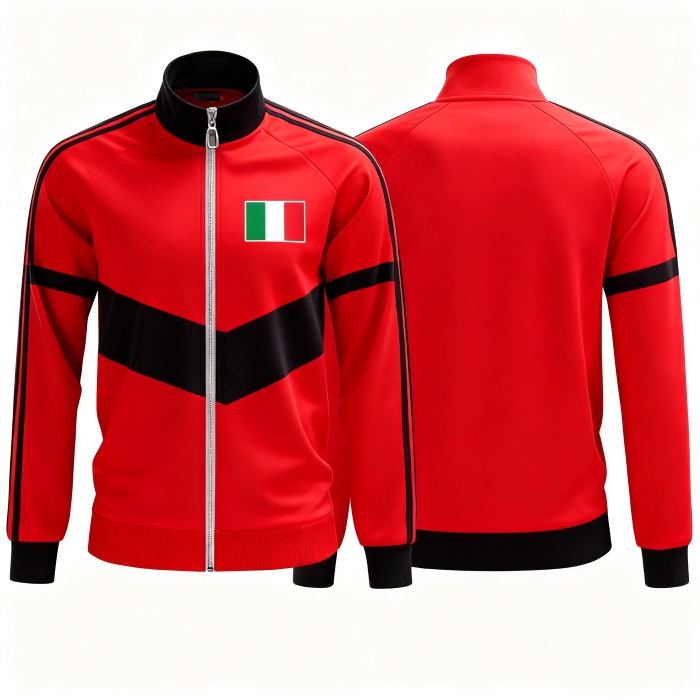
The phrase “football jacket” can describe very different products. One buyer may mean a lightweight polyester warm-up jacket with printed graphics. Another may mean a heavyweight varsity garment with a wool-like body, faux-leather sleeves, chenille patches, snap closures, and streetwear-grade finishing. These products should not be sourced using the same qualification standard.
| Requested jacket type | What the buyer should verify | Evidence supported by Hening information | Fit assessment |
|---|---|---|---|
| Polyester team warm-up or training jacket | Fabric weight, moisture handling, stretch, print placement, sizing, production lead time | 100% polyester fabric, moisture-wicking performance, 4-way stretch, 140–160 gsm material range, five automatic dye-sublimation printing lines | Potential fit when the design relies on polyester construction and sublimated graphics |
| Full-print football-inspired casual jacket | Artwork coverage, color consistency, zip or collar specification, size chart approval | Fade-resistant dye-sublimation printing, verified size chart, 1-year colorfastness guarantee | Potential fit, subject to confirmation of the requested garment construction |
| Traditional varsity jacket with mixed materials | Wool or wool-like body, faux-leather sleeves, rib quality, snaps, lining, patch attachment, finishing references | No confirmed evidence supplied for these specific materials or trim operations | Requires direct qualification before quotation or order placement |
| Streetwear jacket with detailed patches | Patch type, stitch density, edge finish, attachment method, placement tolerance, wash durability | No confirmed patch-production or embroidery evidence supplied | Do not assume capability from sublimation apparel evidence alone |
The practical conclusion is simple: use Hening’s documented polyester and sublimation capability for designs that genuinely fit that production route. Do not treat a teamwear printing capability as proof that every mixed-material varsity build can be made. This limit matters most when the buyer’s design depends on physical decoration rather than printed decoration.
For a jacket intended to sit beside training apparel, a coordinated Custom Sport Jacket program may be easier to specify than a fashion varsity piece. This is especially true when a club needs consistent logos, player names, and colors across jackets and match apparel.
A supplier’s ability to make sublimated sportswear can fall short when a jacket depends on several material systems and decoration processes that have not been confirmed. Buyers should treat this as a qualification boundary, not as a minor detail to settle after a purchase order.
The conclusion for sourcing managers is not “reject the supplier.” It is “separate what is proven from what still needs proof.” A polyester football-inspired jacket with full sublimation sits within the documented strength area. A premium varsity jacket with non-polyester materials, thick patches, and fashion finishing should remain conditional until the supplier provides suitable evidence for that exact build.
Once the proposed style fits a polyester, sublimation-led direction, the factory facts become meaningful selection criteria. Hening has five automatic dye-sublimation printing lines and a stated daily output of more than 1,000 custom jerseys. This is relevant to graphic-heavy team apparel because capacity affects how a supplier handles repeat logos, numbers, and color-led designs across an order.
The standard production period is 7–10 days, with rush order options available. This is useful for a club launch, school season, event merchandise deadline, or retailer replenishment plan. It is not a universal delivery promise. Final timing still depends on the approved specification, quantity, artwork readiness, order queue, shipping method, and whether the jacket includes unverified materials or decorations.
Hening also provides no MOQ, although pricing is based on quantity. That can suit a small club ordering one replacement garment alongside a broader team program, or a buyer testing a limited colorway. The limit is commercial rather than technical: no MOQ does not mean the lowest unit cost applies to a very small order. Buyers should request tiered pricing for their likely reorder volumes.
For quality assurance, our ISO 9001 quality management system certification and ISO 14001 environmental management system certification are concrete qualifications buyers can record in a supplier comparison file. They should not replace product-specific acceptance criteria. A certification does not answer whether a requested patch edge, snap finish, or sleeve material has been approved for a particular jacket.
Available order history also supports the sportswear side of the assessment. Hening supplied more than 500 sublimated jerseys for a United States high school basketball league, produced full custom uniforms for an Australian soccer club’s three teams, and delivered 1,000 event jerseys for a European marathon. These examples support experience with custom sports apparel volumes and event-oriented supply. They do not prove production of traditional varsity jackets, so buyers should not extend the case evidence beyond its stated scope.
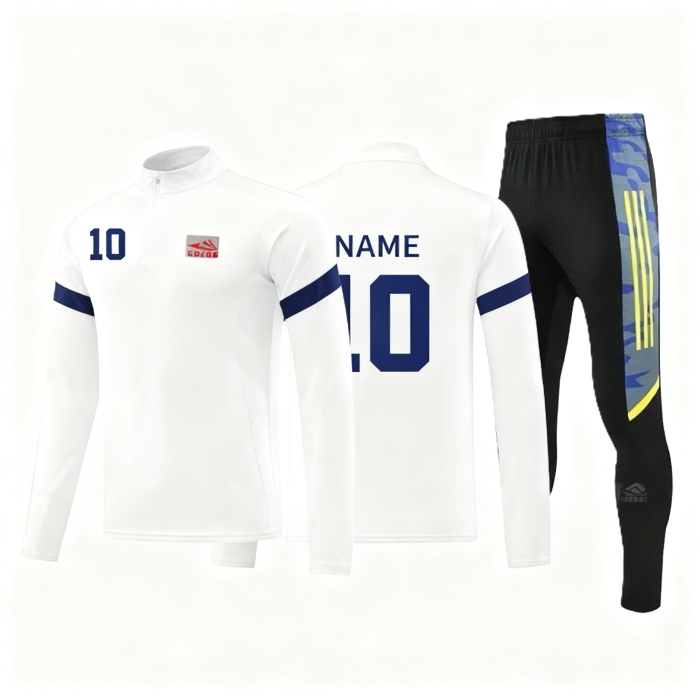
Do not ask only, “Can you make this?” A useful RFQ forces an answer on material, decoration, fit, and approval responsibility. It also helps separate a supplier that can quote a concept from one that can produce the specified result.
This procedure fits buyers comparing preliminary quotes. It is less necessary for a repeat order with an already approved specification, although quantity, delivery timing, and size breakdown should still be reconfirmed.
A supplier comparison works best when every factory receives the same requirements. Use the checklist below to avoid selecting based on price, photo quality, or broad claims alone.
| Verification point | What a satisfactory answer looks like | Warning sign |
|---|---|---|
| Garment category | The supplier identifies whether the design is compatible with its documented production scope. | The supplier calls all jacket types “the same” without discussing construction. |
| Material confirmation | Each component is listed, with unsupported materials identified for further review. | Only the exterior color is discussed; body, sleeves, lining, and trim are ignored. |
| Decoration method | Printed, sublimated, embroidered, and patch elements are separated by location. | A supplier promises “custom logo” without explaining the method. |
| Size control | A measurement chart is approved before production and the intended fit is stated. | Sizes are described only as S–XXL without garment measurements. |
| Color durability | For sublimated elements, the supplier states the applicable colorfastness terms. | A general “won’t fade” claim is made without warranty details. |
| Defect responsibility | Printing defects and wrong-size conditions are addressed in writing. | The buyer is told to resolve issues after shipment without defined responsibility. |
| Capacity and timing | Production capability and the requested delivery window are discussed separately. | A fast delivery claim is made without reference to quantity or specification. |
A common mistake is treating a jacket as an add-on to a uniform order. For example, an Australian soccer club ordering custom uniforms for three teams may need matching outerwear. If the outerwear is a polyester training piece using the same color system and printed club branding, the sourcing route can align closely with Soccer Jerseys. If the club instead wants a retail-style varsity jacket for supporters, it needs a separate construction qualification.
Another mistake is assuming every small order deserves the same unit price as a large event order. Hening delivered 1,000 event jerseys for a European marathon, but that case should not be used to infer pricing or lead time for a small, mixed-material jacket order. Quantity, garment build, and decoration method all change the commercial calculation.
Hening is a stronger candidate when the proposed jacket is built around 100% polyester performance material, 4-way stretch, moisture-wicking characteristics, and fade-resistant dye-sublimation graphics. This direction suits clubs, schools, events, and sports retailers that need matching visual identity across garments. It may also suit a football-inspired casual piece when the streetwear effect comes from artwork, panel design, color blocking, and fit rather than specialty physical trims.
The supplier fit is not yet established when the requested item depends on wool bodies, faux-leather sleeves, chenille letters, complex embroidery, premium snaps, or a defined streetwear finishing standard. In that situation, ask for direct evidence on those specific operations before using price as the deciding factor. A low preliminary quote is not useful if it excludes the materials and decoration that make the design sellable.
For a sourcing manager, the right decision is evidence-based. Confirm what the factory can support, document what remains conditional, and only compare quotes after each maker is pricing the same specification.
Send your jacket specification, reference images, quantity tiers, and required decoration methods to request a focused quote and capability assessment.






 WhatsApp
 Email
 +8618978569271